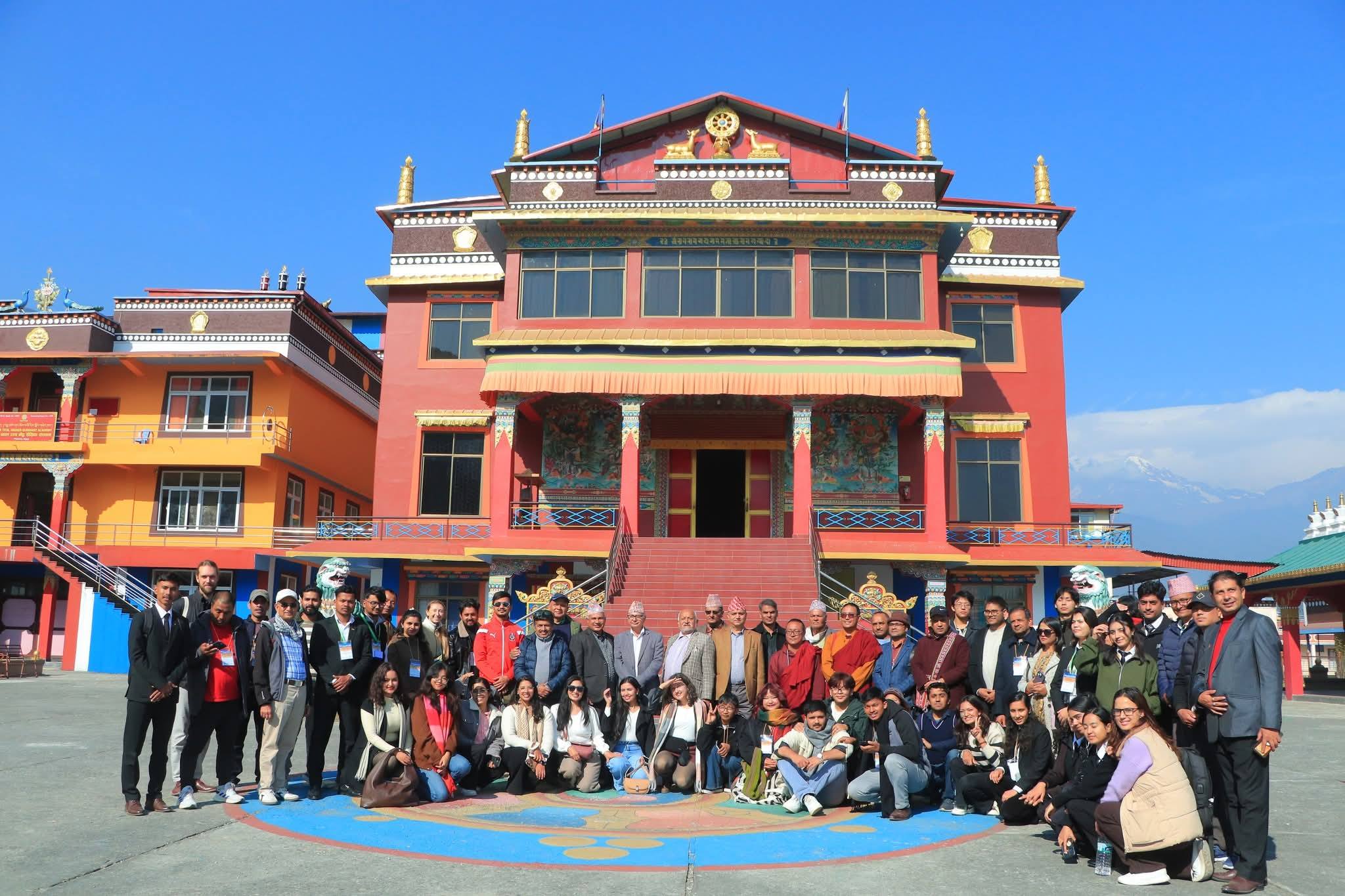
4th International Conference on Rigvedic Himalaya (ICRH-026)
Theme of the Year: Himalayan Biodiversity & Climate Change
Dates: December 7–9, 2026
Venue: IOFPC, Hariokharka, Pokhara,
Introduction
The 4th International Conference on Rigvedic Himalaya (ICRH-026) offers an optimal platform for academic exchange, interdisciplinary dialogue, and scholarly inspiration among experts and emerging researchers in the social sciences, humanities, and environmental sciences, with a specific focus on the Himalayan region of Nepal. Based on our past experiences, ICRH specifically foregrounds Rigvedic references to the ecology and way of life of the Himalayan communities, bridging ancient textual traditions with contemporary environmental and cultural challenges.
Building on the momentum of previous gatherings and dialogues, ICRH 2026 is organized under the theme “Himalayan Biodiversity & Climate Change” This year, the Himalayan biodiversity is spotlighted as the heart of the Himalayan ecosystem, with emphasis on its cultural, spiritual, and ecological significance and climate change as a issue of global concern. We are pleased to announce that the support from the University Grants Commission (UGC) and collaborating partners was instrumental to the success of all three previous conferences. The outcomes of the conferences have already been published in a research journal titled Rigvedic Himalaya, which is indexed in NepJOL (https://www.nepjol.info/index.php/jorh/index). Two volumes have been published to date.
With the completion of this fourth edition, ICRH is set to become an institutionalized, brand platform for discussion and exchange of research and experiences on Vedic perspectives, Himalayan worldviews, and their interconnections with Himalayan cultures, ecology, and resources, extending its reach beyond political boundaries across the entire region.
Location & Venue
Pokhara is the capital of Gandaki Province, situated approximately 200 km west of Kathmandu and 210 km north of Lumbini (the birthplace of Lord Buddha) by road. As the province’s largest city, Pokhara serves as a major administrative, commercial, and economic hub. Recognized as Nepal’s tourism capital, the city lies in a valley flanked by lush green hills to the south and snow-capped Himalayan peaks to the north. Pokhara is also renowned for its lakes, rivers, and diverse cultural heritage sites representing both Hindu and Buddhist traditions.
ICRH 2026 will be held at the Institute of Forestry, Pokhara Campus, in Hariokharka Pokhara, from December 7–9, 2026 situated in in the foothills of the Annapurna massif and the Mt. Machapuchhre in the Pokhara Valley.
MoU between Mukta Foundation & IOFPC
The 4th International Conference on Rigvedic Himalaya (ICRH 2026) is organized within the framework of a formal five-year Memorandum of Understanding (MoU) signed between the Institute of Forestry Pokhara Campus (IOFPC) and the Mukta Foundation on November 26, 2025. Valid until 2029, this MoU establishes a collaborative institutional mechanism to undertake joint research, academic exchanges, conferences, publications, and other scholarly activities in areas of common interest and complementary expertise. The present conference represents a flagship initiative under this MoU, demonstrating the shared commitment of both institutions to advance interdisciplinary scholarship on Vedic traditions, Himalayan cultures, forest ecology, and sustainable resource management. Through this ongoing partnership, IOFPC and Mukta Foundation aim to create a sustained platform for dialogue between humanities, social, and environmental sciences, with ICRH serving as a recurring milestone in that journey.
Previous Achievements
Over three previous editions (2023–2025), ICRH has engaged over 500 participants from more than ten countries, hosted 80 academic papers, and featured keynote addresses from leading scholars in Nepal, the USA, and beyond. Two volumes of the indexed journal Rigvedic Himalaya (JoRH) have been published on NepJOL. The conference has received institutional support from UGC Nepal, Tribhuvan University, Gandaki University, Pokhara Metropolitan City, the Gandaki Province Government, and multiple monastic and community organizations. Inaugural addresses have been delivered by the Chief Minister, Province Chief, and Mayor of Pokhara, reflecting the governmental and cultural endorsement of the themes and perspectives incorporated in the ICRH.
ICRH 2026: Aim, Objectives & Major Themes
Aim
The aim of ICRH 2026 is to provide a rigorous yet inclusive platform for global participants working on Himalayan cultures and ecology to share their ideas, field experiences, and scholarly insights in relation to Vedic concepts and perspectives. It is expected that the outcomes of ICRH 2026 will contribute significantly to the documentation and understanding of living ancient cultures and traditions in the Himalaya and beyond, while also helping to identify holistic solutions to contemporary global challenges; including inequality, civilizational conflict, and climate change.
This year’s special thematic focus is:
“Himalayan Biodiversity & Climate Change.”
Underpinning all discussions will be a holistic approach to knowledge production, resource management, and policy formulation, one that respects indigenous wisdom alongside modern disciplinary frameworks.
Objectives
- To critically examine the ecological, cultural, and spiritual significance of Himalayan forests and river basins through the lens of Vedic traditions.
- To foster interdisciplinary dialogue among scholars, sādhakas (spiritual practitioners), students, and practitioners in the social sciences, humanities, and environmental sciences.
- To document and disseminate indigenous Himalayan knowledge systems and demonstrate their relevance to contemporary challenges such as climate change, food security, and sustainable tourism.
- To institutionalize ICRH as a regional brand platform for Vedic-Himalayan scholarship that extends beyond national boundaries.
- To promote academic and cultural tourism in Gandaki Province by integrating conference activities with field-based learning in the living Himalayan landscape.
Major Themes
ICRH 2026 invites contributions under the following major themes:
- Rigvedic and Vedic texts, philosophies, and interpretations
- Himalayan social/political organization, economy and trade, migration and mobility, spirituality, rituals and symbolism, sacred landscapes
- Himalayan ecology and natural resource management: biodiversity, indigenous resource management, forest and non-timber forest products, eco-tourism, watershed and pasture management
- Contemporary issues on climate change, pandemic, food security, rising distrust on public institutions, conflict, AI and others examined in Vedic and Himalayan contexts
- Other relevant themes and perspectives on Vedic discourses and Himalayan worldviews
Registration & Modality
The ICRH will feature Keynote addresses, Thematic lectures, Paper presentations, Poster presentations, and Policy dialogues. Field visits to a culturally and ecologically significant site in the Pokhara valley will be organized for the registered participants and speakers.
Registration opening: August 15, 2026
Registration ends on November 20, 2026
ICRH-026 Registration* | Regular Fee (NRS) | |
Member** | 2K | |
Non-Member | 4K | |
*For residential participant Rs 2K is added in the given list.
**Member: Advisors and members of ICRH, member of Mukta Foundation, faculties and staff of IOFPC, and limited participants from sponsors and supporting institutions.
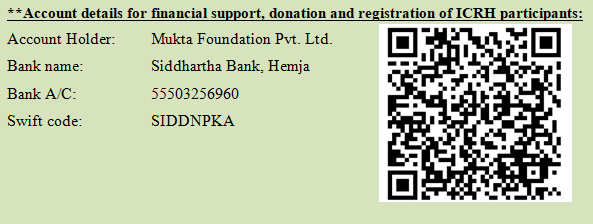

Scan the QR given above to go to the Conference Registration Form (CRF) for the ICRH-026. All participants and presenters have to register by filling the CRF given.
Contact Information
Institute of Forestry Pokhara Campus (IOFPC), Hariokharka-15, Pokhara
Mob/WhatsApp: 00977-9856000288/ 00977-9846041259
Email: icrh@iofpc.edu.np/ mfpokhara@gmail.com
Website: https://muktafoundation.com.np/conference-icrh/conference-icrh-2026/